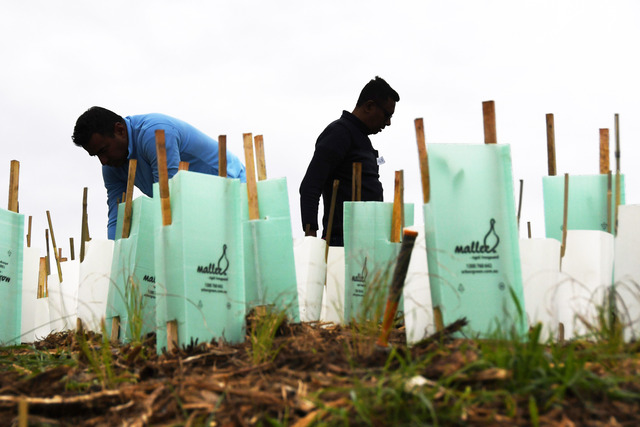
This summer’s repeated 40-degree days have made one thing unavoidable: Melbourne’s suburbs are heating up, and trees are no longer decorative extras.
Councils across the south-east now speak urgently about urban cooling, heat mitigation, and climate resilience, with shared targets to lift tree canopy to 15 per cent by 2028.
Which makes the looming closure of Greenlink Sandbelt Nursery deeply awkward.
For more than 30 years, Greenlink Sandbelt Nursery has supplied indigenous plants of local provenance to councils, schools, community groups, and revegetation projects across Melbourne’s sandbelt.
Much of the vegetation now thriving in, wetlands and restored landscapes began life there.
The nursery receives no ongoing government funding and survives entirely on plant sales and volunteer labour.
After 25 years on land provided by Spring Valley Golf Club, Greenlink must vacate by July 2026.
Despite approaching councils, golf courses and infrastructure bodies, the nursery has been unable to secure a new site.
Here is the contradiction. Councils are rapidly expanding sporting-field capacity by replacing natural turf with synthetic surfaces, delivering three to four times more hours of use.
Hybrid systems now knit synthetic fibres into grass, increasing durability while preserving the look of turf.
These projects are approved in the name of health, participation, and community wellbeing.
Yet an indigenous nursery that grows the trees councils rely on cannot find space on public land because it fails the definition of “active open space.”
Growing shade, cooling suburbs, and supporting biodiversity does not count as activity.
If Greenlink closes, trees will die.
Judith Sise OAM